


For most of modern wellness, changing how we feel has meant putting something into the body. We drink coffee when we want more energy, take melatonin when we’re trying to sleep, reach for supplements when we’re feeling depleted and increasingly turn toward products designed to help us manage everything from stress to focus to recovery. Even many of the technologies entering the wellness space are built around measurement: tracking our sleep, monitoring our heart rate, calculating our recovery and giving us increasingly precise information about what is happening inside us.
But there is another question emerging alongside all of this measurement: what if we could influence how we feel without necessarily putting something into our bodies?
That is the idea behind Hapbee, a wellness technology company developing wearable devices designed to influence how people feel through what it describes as ultra-low-frequency electromagnetic signals. Rather than ingesting a substance, Hapbee’s technology is intended to deliver signals associated with experiences such as calm, focus, energy and sleep. The company says its technology can record electromagnetic signatures associated with certain compounds and reproduce those signals through its devices, creating what it describes as a way to experience some of the effects associated with those compounds without actually consuming them.
It is an unusual proposition, and one that sits at an interesting intersection of wellness, technology and our growing interest in the internal state. The idea is not simply that we can track how we’re feeling, but that perhaps technology could eventually become another way of influencing that experience.
From Tracking Ourselves to Influencing Ourselves
One of the biggest shifts in wellness technology over the last decade has been our movement from observation toward intervention. We can now collect enormous amounts of information about ourselves. Wearables can tell us how long we slept, how much we moved, how our heart rate changed overnight and, increasingly, how our body appears to be responding to stress. That information can be incredibly useful, but it also creates an obvious next question: once we know what is happening, what can we actually do about it?
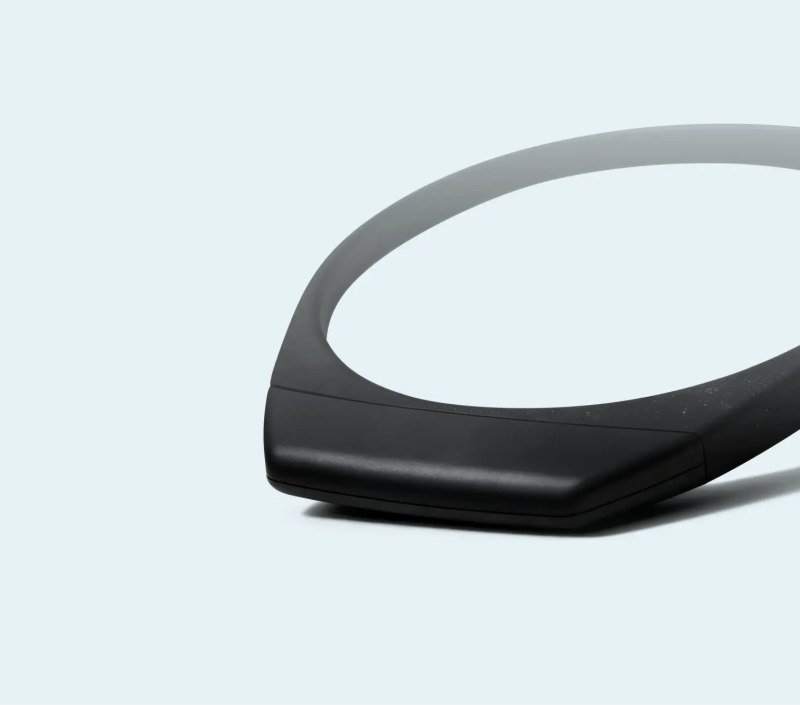
Hapbee is approaching that question from an entirely different direction than a supplement or medication. Its products are designed to deliver low-power electromagnetic signals through wearable devices, which users can control through an app. The company currently offers products including the Hapbee Neckband and Smart Sleep Pad, along with different signal experiences intended to support states such as sleep, calm, focus and energy.
The distinction is important. A cup of coffee changes your physiology because caffeine enters your body. A melatonin supplement introduces a hormone that interacts with receptors involved in the sleep-wake cycle. Hapbee is proposing that a different kind of input—an electromagnetic signal—may be capable of influencing biological processes without introducing a chemical substance.
That is a much bigger proposition than simply creating another wellness gadget, which is why the science matters.
What Does the Research Actually Show?
Hapbee has conducted research on its technology, including a five-month analysis involving users who were already using both Hapbee and Oura Rings. Of the participants who responded, 31 provided usable sleep data for at least one Hapbee signal. The company analyzed thousands of sleep sessions and reported improvements in several sleep-related measures among users of its Smart Sleep Pad. (Hapbee)
The company has reported, for example, that users experienced an average increase in sleep duration of approximately 21 minutes per night, along with improvements in sleep efficiency and reductions in wake time after falling asleep. Hapbee has also reported improvements in certain Oura sleep measures, including REM sleep, when users employed particular signals. (Hapbee)
Those findings are interesting, but understanding what they do and do not demonstrate is equally important. The study was based on existing Hapbee users who volunteered their historical or ongoing wearable data rather than being randomly assigned to use Hapbee or a sham device in a blinded clinical trial. That means the findings can show an association between Hapbee use and changes in sleep measures, but they cannot by themselves establish that Hapbee was responsible for those changes.
This distinction comes up repeatedly in wellness. A product can have research behind it without every claim associated with the product being clinically established. The quality of the evidence depends on what was studied, how it was studied, who conducted the research, how many people participated and whether the result can be replicated under controlled conditions.
Hapbee itself has also described earlier testing designed to determine whether participants could distinguish between certain signals and sham conditions. The company reports that some signals were distinguishable under particular testing conditions, while other signals that were more similar to one another were more difficult for participants to differentiate. (Hapbee) That is interesting as an early finding, but it is not the same thing as demonstrating that a particular signal produces the same physiological effect as the substance or state it is intended to represent.
The Technology Behind Hapbee
Hapbee’s technology originates from EMulate Therapeutics, which developed the platform that Hapbee uses in its consumer products. The technology is based on ultra-low radiofrequency energy, or ulRFE®, and the company describes it as using very low-power electromagnetic signals. Hapbee says its signals are based on recordings associated with substances and biological interactions and are then reproduced through its devices.
The premise is difficult to understand because it sits outside the more familiar framework through which most of us think about supplements and pharmaceuticals. When we take a substance, we understand the basic concept: a molecule enters the body and interacts with biological systems. The idea that an electromagnetic signal could somehow reproduce an effect associated with that molecule requires a different model of how biological information might be communicated.
There is research into electromagnetic stimulation and biological effects more broadly, but that broader research should not automatically be treated as evidence that Hapbee’s specific consumer products produce the effects the company describes. There is an important difference between showing that biological systems can respond to electromagnetic stimulation and demonstrating that a particular signal delivered by a particular consumer device reliably produces a meaningful human outcome.
That is why I find the company’s work interesting without thinking we need to arrive at a definitive conclusion about it yet.

The Experience Is Part of the Question
There is also something else worth considering when we talk about technologies like Hapbee: the experience of using a wellness tool is rarely completely separate from the ritual surrounding it.
We already understand this in everyday life. We make tea before bed, dim the lights, take a bath, put on music, roll out a yoga mat or sit in the same chair to meditate. Over time, those actions can become associated with particular states of mind. The ritual itself becomes a signal that tells us we are transitioning from one state to another.
Hapbee introduces technology into that process. Putting on a device and selecting a particular signal creates an intentional pause in the day and establishes a deliberate cue around the state a person is trying to cultivate. That does not tell us whether the electromagnetic signal itself is responsible for the resulting experience, but it does remind us that our relationship with wellness tools is often more complicated than a single active ingredient or mechanism.
This is particularly relevant when the desired outcome is subjective. Calm, focus, energy and relaxation are experiences rather than simple laboratory measurements. They can be influenced by expectation, environment, context, ritual, sleep, stress and countless other variables. A person can genuinely feel different after using something without that experience necessarily telling us exactly why they feel different.
Both things can be true at once: the experience can be meaningful, and the mechanism can still require further investigation.
Where Hapbee Gets Interesting
What interests me most about Hapbee is not necessarily whether it represents the final answer to anything. It is that the company is participating in a much larger shift in the way we think about wellness.
For a long time, wellness was primarily concerned with what we put into our bodies and what we did with them. Nutrition, exercise, supplements and sleep formed much of the conversation. As technology developed, we became increasingly interested in measuring those things. Now we seem to be moving toward a different category of questions: How do we influence our attention? How do we regulate stress? How do we change our relationship with sleep? How do we support focus? And perhaps most fundamentally, how do we influence the way we experience our own lives?
That is a fascinating direction, but it also comes with a responsibility to become more discerning.
The wellness industry has a tendency to turn an interesting possibility into a definitive promise very quickly. Something can move from preliminary research to a marketing claim and from a marketing claim to something people feel they are supposed to be doing. We have seen this happen with supplements, wearables, recovery technologies and countless other categories.
I don’t think the answer is to become cynical about every new technology. It is to become better at holding uncertainty.
We can be curious about something without deciding that it works for everyone. We can acknowledge that a person has had a positive experience without turning that experience into a universal prescription. We can look at research without pretending that all research carries the same weight.
Do We Need to Change Every Internal State?
There is another question underneath all of this that may be even more important.
As wellness becomes increasingly sophisticated at influencing how we feel, are we becoming too uncomfortable with simply feeling?
Not every uncomfortable state is a problem that needs to be optimized away. Fatigue can be a message that we need rest. Anxiety can sometimes tell us that something in our environment or relationships needs attention. Boredom can create the space for creativity. Discomfort can be part of growth. There are experiences we should absolutely seek support for, and there are circumstances where medication, therapy, medical care or other interventions are essential. But there is also value in learning to distinguish between something that needs to change and something that simply needs to be felt.
That is why I think the most useful way to approach any new wellness technology is to start with the same question we should ask of everything else we bring into our lives: Why?
Why am I using this? What am I hoping it will change? Does it actually make a meaningful difference in my life? Am I using it because it supports something I already know I need, or because I have been persuaded that there is something wrong with me that needs fixing?
Those questions don’t make a technology less interesting. They make our relationship with it more intentional.
A Different Kind of Wellness Technology
Hapbee is ultimately exploring a possibility that would have sounded unfamiliar to most consumers not long ago: that technology might not only measure our internal state but potentially interact with it.
Whether that possibility becomes an important part of the future of wellness remains to be seen. The research is still developing, and some of the company’s claims deserve continued independent investigation. But perhaps that uncertainty is part of what makes this category worth watching.
The future of wellness probably won’t belong entirely to supplements, wearables, meditation apps, recovery clubs or electromagnetic technologies. It will likely be a combination of many different approaches, some of which will prove useful and others that won’t.
The challenge for us as consumers is not to predict which one will win. It is to become discerning enough to evaluate them as they arrive.
Hapbee offers one possible glimpse into where that future could go: a world in which wellness isn’t only about measuring the body or changing what we put into it, but about exploring the relationship between technology and our internal experience.
And perhaps the most interesting question isn’t whether we will eventually learn how to change how we feel.
It is whether, as we become more capable of doing so, we will also become better at understanding when we actually need to.


